
Welcome to the first post of my technology blog which will cover computer related topics like languages, programming, and hardware. Also computer history will be covered from time to time. In fact, this post covers some of my computer history.
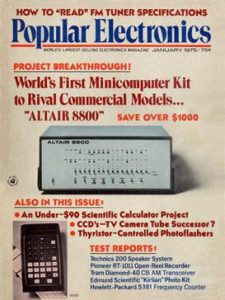
I was lucky to have been around at the start of the personal computer revolution. When I was still a senior in High School, Popluar Electronics published their January 1975 issue which had as its feature story, the Altair 8800 Minicomputer kit. This was part 1, part 2 would be in the next issue. I did buy these issues. They are long gone now. The complete kit included an Intel 8080 microprocessor, 256 bytes of RAM, a front panel with light and switches, a metal case and an 8 amp power supply for $397. Fully assembled it was $498. This cover launched the personal computer industry.
The one class I took during my senior year that helped me a lot in my computer career, was typing. The quick brown fox jumps over the lazy dog. Knowing how to type helped with writing term papers too. I didn’t have a word processor back then, I had little portable manual typewriter.
After graduating from High School, I went to the University of Maryland for the 1975 fall semester. I became a Computer Science major. At the time, the University of Maryland was among only a handful of schools that were offering BS, MS, and Phd degrees in Computer Science (CMSC). There weren’t as many students in Computer Science at that time like there is today.
I don’t remember the name of the first CMSC class I took. It might have been CMSC 100. But the first computer language that I was formally introduced to was SIMPL-T. I don’t remember much about the language, but the teacher was Dr. Victor R. Basili. A friend of mine that I used to work with, also worked with Dr. Basili years later. It seems that Dr. Basili is still affiliated with the University of Maryland’s Computer Science Department. And in 2020, it will be 50 years since he started there. He is currently a Professor Emeritus.
That’s it for now. Catch you later.